I Opening Clarity
Home page and welcome to I Opening Clarity
About me and my work
Psychometrics
Coaching
Corporate
Counselling
E-therapy and councelling
Self-image and self confidence
NLP
Contact me
 

NLP - NEURO-LINGUISTIC PROGRAMMING

What is it?
In simple terms its how the brain works, the connection between language and behaviour. The structure of subjective experience, or how we do things in our mind, how we know what we know.

NLP allows you to have the kinds of experiences you want, by learning how you know what you know you can change your responses to things. The neurological system regulates how our bodies function, language determines how we interface and communicate with other people and our programming determines the kinds of models of the world we create. Neuro-Linguistic Programming describes the fundamental dynamics between mind (neuro) and language (linguistic) and how their interplay affects our body and behaviour (programming).

NLP is a collection of techniques (tools) that enable you to change how you think and the way you think, which enables you to eliminate unwanted habits, change negative emotions, and improve self-image and self esteem to become the person you want to be. Most of the time, we are our greatest enemy. From childhood on we are literally scripted like a program by things that were said to us by our parents, other close relatives, teachers or friends. Experiences that happen to us are also stored in our memory and our brain is making conclusions about what we can do and more importantly, what we can’t or shouldn’t.

This way of experiencing reality results in a set of rules that become our belief-structure and therefore our mirror of 'reality' and as an important part of it our own identity. But this reality isn’t a fixed thing, it is an image, a perception we have in our minds. If it comes to our own self these beliefs can be supporting for us, or limiting.

You may not even be aware of such self-limiting beliefs, but certainly they are there inside. Even if you made a lot of personal progress in working on yourself, there are a lot of areas were limiting beliefs are holding you back.

If such rules are working deep in our unconscious mind, these limiting beliefs are constantly influencing and distorting our possibilities and lives. If you can become aware of these and identify them, you are able to change them, and by that, change your reality for the better. If we live by limiting beliefs formed in the past, conscious or unconscious, we are doomed to repeat the results of the past over and over and thereby reaffirming these stupid belief-structures.

The important thing is to have empowering beliefs, so that we are supporting ourselves instead of standing in our own way.

Normally, the conscious mind can only handle so many items of information at any given time. There is a reason for this. If we didn't actively delete information all the time, we'd end up with much too much information coming in. In fact, you may have even heard that psychologists say that if we were simultaneously aware of all of the sensory information that was coming in, we'd go crazy. That's why we filter the information.

So, the question is, when two people have the same stimulus, why don't they have the same response? The answer is, because we delete, distort, and generalise the information from the outside. NLP studies individuals’ experiences: how our thoughts, actions and feelings work together to produce our experience. It does NOT assume that we all do this the same way.  In NLP we know that each person has a unique style of learning, perceiving and responding to the world. NLP is inherently respectful of differences.

NLP works with how you do what you do. How you take in information from the world around you, what you do with that information inside your head, and how what you do results in states of depression or joy, a healthy or unhealthy physiology and behaviours that lead to positive outcomes.

NLP is about language:
Language affects how we think and respond. The very process of converting experience into language requires that we condense, distort, and summarise how we perceive the world. NLP provides questions and patterns to make communication more as we intend. NLP teaches us to understand how language affects us through implicit and embedded assumptions.

NLP describes, in very precise terms, the images, sounds, and feelings that make up our inner and outer world. How do we know what we know? How do we do what we do? For example, how do you know that a pleasant memory is pleasant? How do you know when to feel scared or happy at certain times? How do you like or dislike something? How do you learn a subject easily, or not? NLP provides us with the equivalent of a user’s manual for our brain - NLP techniques demonstrate how we `code’ our experience. When we understand the specific ways that our brains make distinctions, then it is easier to make changes, to learn and to communicate effectively.
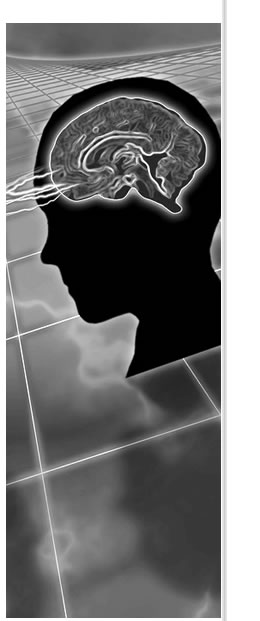
silhoette of a skull and brain
My will shall shape the future. Whether I fail or succeed shall be no man's doing but my own. I am the force; I can clear any obstacle before me or I can be lost in the maze. My choice; my responsibility; win or lose, only I hold the key to my destiny - Elaine Maxwell Blue Monkey
If only you look at what is, you might never attain what could be" Blue Monkey